Monday, September 26, 2022

a shamelessly subjective recollection with scholarly implications

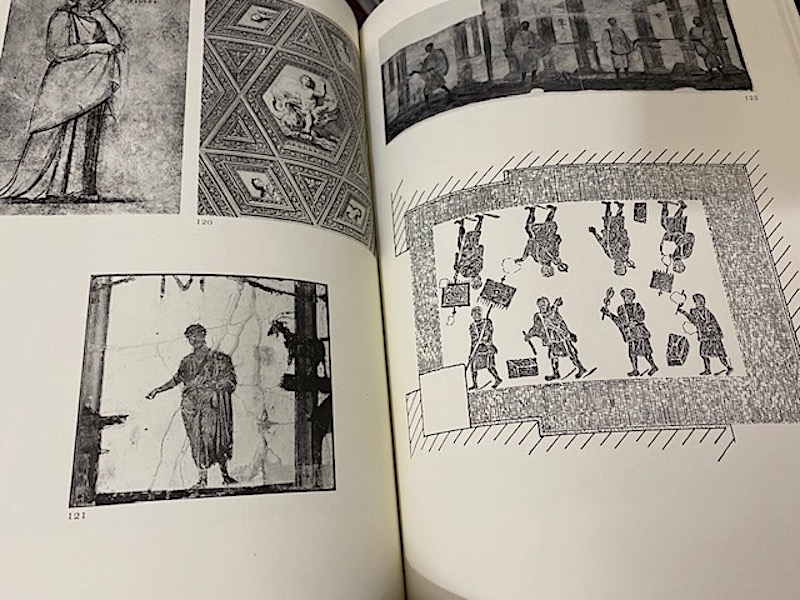
The arrival of Rosh Hashanah put me in mind of the time, very long ago, when my freshly arrived in graduate school self discovered not only Elie Wiesel's novel The Gates of the Forest from which the above Hasidic tale is taken, but some of the most beautiful and astonishing books that the Bollingen Foundation ever published in its Bollingen Series. The twelve volumes of Erwin Ramsdell Goodenough's Jewish Symbols in the Greco-Roman Period were no more than a prolegomenon to the research he had contemplated on the relationship between early Christianity and the mystical Judaism exemplified by Philo of Alexandria, but that grand finale never got beyond a single essay on Justin Martyr. The dozen volumes, however, contained an evocative array of subjects, such as "Pagan Symbols in Judaism," "Fish, Bread, and Wine," and above all, "Symbolism in the Dura Synagogue." Dura-Europos was a strategically important outpost garrison town on the border of the Eastern Roman Empire. When it fell to invaders, an accident of the defensive wall that had been hastily reinforced preserved the wall drawings from the world's oldest known Christian house church, and elsewhere along the wall, a Jewish synagogue that contained a spectacular array of floor-to-ceiling narrative paintings of key moments in stories from scripture. Goodenough interpreted these in terms based on his earlier hypotheses about Jewish hellenistic mysticism of which the philosopher Philo was only the most prominent interpreter. I found it all emotionally intoxicating, especially when I paged through the illustrations in volume 11 without realizing that the synagogue art was mostly reproduced in the color illustrations while the bulk of the black and white ones were examples of parallel models from what Goodenough and most other folks called Greco-Roman paganism. Here, without further commentary, is some of the stuff that set me on my ear back when I was suffused with excitement without much accompanying understanding. It still gives me an emotional rush, even if I have intermittently revisited the topic over the years and have a slightly more nuanced set of opinions about the whole topic. (There have been a host of other archaeological discoveries to render the picture even more complex than Goodenough thought it was.)

Monday, August 29, 2022

Notes on Two Atlanta Exhibitions (a Transitory Annotation for the Sake of My Local Readership)

“Is this trip really necessary?” was a motto on World War II posters intended to remind U.S. civilians who were putting up with gasoline rationing, along with restrictions on buying tires and new cars (there weren’t any), that they had better think twice before wasting their limited travel resources on trivialities, or even on ill-thought-out trips for essentials. When it comes to art, of course the trip is necessary. Reproductions, whether in books or in high-quality digital versions online, aren’t the same thing on several levels, even for art in the age of its technical reproducibility, to use the contemporary translation of Walter Benjamin’s oddly rendered phrase about “the age of mechanical reproduction”— movies may be viewed more on tablets or phones than in theatres, but most of them were designed to function on a much larger screen, just as photographs intended for exhibition were created with a particular scale in mind, and were certainly not meant to be viewed in the internally illuminated form online viewing gives them—even in the case of digital prints.

So I feel strange recommending the notion that there are shows that ought at least to be looked at in online images accompanied by whatever curatorial statements originally accompanied them. But for a variety of regrettable reasons, the shows I am writing about here didn’t get the coverage they deserved, and this is their final week before closing.

Of course, it remains the case that most of us will only experience almost all of the world’s art shows in whatever form of documentation the galleries and global biennials choose to put online, just as we used to be limited to whatever was shown on the paper invitation to the opening or in the print catalogue describing the exhibition. And seeing a digital simulacrum of the whole show is still better than having no idea at all of what it looked like.

Thus I am pleased that Sandler Hudson Gallery has provided an online catalogue of William Downs’ curatorial efforts in “An Empty Space to Fill (Phase Two.)”:

https://issuu.com/sandlerhudsongallery/docs/_an_empty_space_to_fill_phase_two_

It is obvious, just looking at the juxtaposition of artworks, that Downs has thought about the interplay of palette and the visual rhythm of internal composition in deciding how to make this exhibition a coherent experience. He also assembled a range of styles and perspectives on art and on the world that it would have been interesting to analyze, given but world enough and time. (Just as writers are always looking for the perfect reader, I suspect curators are always looking for the perfect viewer and/or critic, the one who will get out of the show everything they put into it.) I’m truly sorry that the chance circumstances of the month of August allowed this show to slip through the interstices of art journalism.

It closes on September 3, so friends living in metro Atlanta still have a number of days to see the show for themselves, in person.

Even more so do I regret the disappearance without commentary of Douglas Baulos’ “Night’s Hand on Your Shoulder,” curated by Lisa Alembik for Swan Coach House Gallery. Balios’ citation of quilting strategies and animal symbolism in the composition of symbolic portraits and other elaborate pieces of mysterious imagery deserved the kind of unpacking that I wasn’t capable of tackling even had I been given the opportunity. And once again because of the vagaries of the accidental gaps of August, nobody else took up the challenge either.

I am posting a couple of detail shots here more in the nature of a teaser than elucidation of anything. But again, friends inclined to make the journey can see the work itself, and read Alembik’s acutely perceptive curator’s essay, at the gallery through September 8.

Monday, December 6, 2021

this one could use about fifty bibliographic footnotes, but for now, here goes

In an M.A. thesis I was never able to turn into something publishable, I remarked that Joseph Campbell’s The Masks of God was a flawed effort at encompassing the whole field of mythology that needed to be corrected in very fundamental ways but not discarded in its entirety. Reading some survey texts written for a general audience (and I get more general all the time as the decades pass since my doctorate), I am recalling some of the passages in volume one, Primitive Mythology, a title that already suggests some of its difficulties. But its grounding of the impulse towards emotionally committed storytelling in basic human characteristics and the even more basic biological characteristics that underpin them seems like a reasonable starting place for reframing without reductionism.

As a much-derided twentieth-century thinker once wrote, when physics explains the nature of light, nobody expects that as a result there will be no longer be any light.

In fact, we probably need to think more about the relationship between our hard-wired tendency to jump to conclusions and our childhood penchant for making things up that we know aren’t true, alongside things that we wish were true but right now are not, and things that we think explain the full truth of things (but really don’t).

Reality stays constructed that way in the grown-up world, and the greatest dilemma of human societies may be the way in which that tendency to construct stories is exploited and expanded for purposes of social domination on the one hand, and individual gratification on the other. Few people grasp the reasons why they not only distort their own perceptions of the world around them, they fail to see the consequences of those distortions. Even when they are grasped, nobody ever grasps them fully. The best mystical traditions were devoted to uncovering those distortions, even though most of what is called mystical is as blindly unaware of its distortions as the hardest-nosed rationalism, which is almost always devoted to excluding as much of reality as it can manage.

A science of the imagination really ought to be possible that would be devoted to eliminating the most commonplace and curable distortions, while heightening the awareness of the inevitability of distortions and their useful emotional functions, and trying to cultivate more satisfactory versions of them. As it is at present, the human ability to imagine things that do not reflect the world as it ordinarily is has too often been divided up into unpleasantly sterile categories: on one hand, fantasies that placate the starved demands of the inner child that has never left us (and usually do so with embarrassing simplifications); on another, hypotheses for future social and/or technological scenarios that take into account all the factors except those unfulfilled infantile needs; and as a corollary of the latter, fantasies of all sorts that are regularly taken for the hard facts about how things are and how things have to be.

These differently distorted visions of the world can’t be cured by the ordinarily recommended methods. I gave examples of these in an earlier draft of this, but then decided to put my concluding paragraph into practice.

The best of the world’s mystics really were trying to break apart the ossified structures that had become tools for self-destruction of the species, and to replace them with connective forms of awareness that would be both supple and rigorous. But of course they didn’t use those terms, and the frameworks they used were shaped by the cultures in which they lived, even as they sought to reshape those cultures. And their practical insights were turned into superstitious repetitions of meaningless practices almost as soon as they had been articulated.

And what, exactly, lay beyond the margins of their merely practical insights is something that is barely open to exploration, much less comprehension. But they taught us that it is our job to explore it and comprehend it. Some of them said that that task is the only reason that we are here, though that assertion always was open to contestation and/or interpretation. The contestation and/or interpretation sometimes led to bloodshed, which is the way we humans like to resolve our disagreements a large part of the time.

We have more pieces of the human puzzle available to us today than ever before in this present cycle of civilization (and probably than in all the previous cycles, but we’ll never be sure) but the pieces need to be put together in a different order, or put together in the first place. And all the flaws and predilections of our mammalian inheritance combine with our inventive capacities to make things up that make us feel better or lend us a competitive advantage, creating prevailing forces that make that happy outcome unlikely to happen.

One place to start might be by cultivating an awareness of people’s many triggering mechanisms, and framing discussions in terms that will not set off antipathy right from the start. But almost nobody seems to know how to do this, even though the tools with which to learn how to do it are readily available.

Monday, July 19, 2021

an explanatory footnote to the previous post

I have no particular enthusiasm for Eugene Thacker. But I am struck by his remarks on the relationship (even though it is an inverted relationship) between mystical theology, the experience of the sublime, and "the fantastic" and contemporary attempts to grasp the age of the hyperobject and potential planetary extinction.

I need to refine my own thoughts on these topics, and have promised analytical essays for too long a time. Thacker's observations are enough to spur me into motion, I hope. I hope.

summing up one philosopher's take on any number of my past topics, by excerpting a Eugene Thacker interview

The old maxim “All things come to those who wait” is self-evidently not true (my all-expenses-paid invitations to the Helsinki or Riga Biennales haven’t showed up yet, for example) but some of the topics on which I have been promising for years now to write my own reflections are dealt with, albeit obliquely, in Daniel Beatty Garcia’s 2019 interview with Eugene Thacker for the culture-and-fashion site and print magazine 032c. I have strung together some highlights that I think are obviously relevant to the several topics on which I have been writing for the past few decades, initially in Art Papers magazine but more recently in my joculum.dreamwidth.org blog and counterforces.blogspot.com. (I thought I included a brief discussion of Thacker’s books in my 2015 “History of Religions and Cultural Fashions Revisited” essay in Mihaela Gligor, ed., From Influence and Confluence to Difference and Indifference: Studies on History of Religions, which you may download free of charge from Cluj University Press, or you can download just the essay from academia.edu, though you may have to sign up for a free account. But on consulting the text I discover that I only cited some of his companion philosophers on the same subject matters. Never mind.)

https://032c.com/monstrous-thoughts-philosopher-eugene-thacker-on-the-new-golden-age-of-horror

[The sentences set off by triple hyphens are Daniel Beatty Garcia’s responses to Eugene Thacker’s remarks.]

For me, the most interesting horror criticism isn’t necessarily academics from film studies writing about horror films. I’m more inspired by theologians writing about religious experience, for instance. They aren’t talking at all about horror film, but there’s something in what they are talking about that resonates with the kind of films that I’m interested in. …if you look, say, at mystical traditions, they’re simply using the terminology of religion or theology to talk about the same structural issue, which is a horizon to human understanding. ---In that sense you could say that the ancestor of modern horror is negative theology.---

....

And you see some of these motifs historically: in Tarkovsky, in Ingmar Bergman’s films – Through a Glass Darkly especially – all the way back to German expressionism.

It’s also there in a lot of Asian horror. There’s a lot of film coming out of South Korea that I find really compelling. There’s a recent film called The Wailing, and another called A Tale of Two Sisters. Both of these not only have that slow horror feeling about them, they also explicitly deal with a dilemma: is something supernatural happening, or is it all in my head? You have a split between the scientific and the religious, or the psychological and the supernatural, and an uncertainty that’s held all the way through to the end. That’s really hard to do, and it’s another example of just holding or inhabiting uncertainty and confusion and not trying to resolve it too easily.

---That sustained uncertainty – what the literary critic Tzvetan Todorov calls “the fantastic” – and that slowed down dread seem to be spreading. Part of the movement comes from the other direction – other genres incorporating horror tropes, directors like Nicolas Winding Refn using the Giallo horror aesthetic.--

Absolutely. Crime thrillers like You Were Never Really Here, Lynne Ramsay’s film. These are out of genre, but you can see how they’re importing that same sense of slow, almost lyrical dread. There’s again this zoomed out sense that these characters aren’t really making decisions. There’s some other nebulous set of forces, and the human beings are just puppets. That it’s leading them to some end.

Sometimes this is expressed visually. I just watched this TV show, The Terror. It uses a technique you see a lot in film in which you cutaway to the landscape. The contrast is between the smallness of human beings – the intensive little human drama happening aboard this ship – and then this vast indifferent landscape that is surrounding it. Again, there’s some resonance between that sort of experience and earlier accounts of mystical experience or religious experience.

---Couldn’t this experience of our smallness in front of the vastness and incomprehensibility of nature be a positive one? Poets have called it “the sublime.”---

Of course, for some philosophers like Kant there’s a happy ending to the story, because human reason is able to recognize this limit and then say, “Well, okay, that’s off limits, but within this domain we can obtain a certain level of mastery.” It’s interesting to quote somebody like Lovecraft in juxtaposition to Kant, because they’re both talking about that distinction between the world in itself and the world as it appears to us, but Lovecraft goes all the way, and says that there is no moment of redemptive reason.

---Bruno Latour has an interesting take on this. He points out that if new research into the Anthropocene shows the nonhuman world to be marked at every point by us, human influence has “scaled up” to the extent that we are no longer so small compared to nature. So experiencing the sublime, that feeling of being dwarfed, becomes impossible. What this shows, for him, is that what we took to be an unreactive or indifferent nonhuman world was in fact sensitive all long, and that we are enmeshed in it at every point.---

There’s some interesting things in those kinds of theories, but they are still heavily anthropocentric. I think one of the lessons of the Anthropocene is that there seems to be a species-specific solipsism that we’re so stuck in that we’ve actually named an epoch after ourselves.

---What are Anthropocene theories missing?---

They usually ignore two kinds of indifference at work. The first is that we can call the world whatever we want and measure it however we want – there’s still the unbreachable opacity of the something-else out there reacting or not reacting. The second kind of indifference is more specifically contemporary. If you look at the tradition of the Gothic novel, there’s a tension between science and religion, and often that boils down to a conflict between the rational and the non-rational. Now added to that is something we could call “cold rationalism.”

Every day you can look at The Guardian, and there’ll be some article with a lot of facts and data about the amount of biomass we consume, or the sixth mass extinction, or whatever. We’re inundated with this big data level of horror. It’s not so much a failure of science – the science works almost too well. What it reveals to us is exactly how indifferent the world is to all of our attempts to master, or control it, or produce knowledge about it. Authors in the early 20th century like Lovecraft and other “weird” authors already understood that the more horrifying path was not anti-science, the non-rational. Far more horrifying is what science will reveal.

Thursday, June 17, 2021

Welcome to my world, or discovering the extreme self before the extreme self was cool, or even digital

Today is the official publication date (in Europe, but not in North America) of “The Extreme Self: Age of You,” the followup to “The Age of Earthquakes” that Hans Ulrich Obrist, Douglas Coupland and Shumon Basar compiled with the collaboration of a slew of artists and designers. I’ve ordered a copy despite the fact that the shipping costs as much as the book, because (and this is increasingly characteristic) I am afraid that by the time it finally becomes available through Amazon US, I’ll have moved on to other research areas, even though this is a research area that it is impossible to move away from because it is me and how I do things in this rapidly altering era, and you and how you do things, and maybe you more than me. I remember how by the time Ernst Bloch’s “The Principle of Hope” finally became available in English, nobody, me included, felt like reading it anymore, because the circumstances that had made it seem urgently relevant had been altered beyond recognition. I joke about “you more than me” because it has just now dawned on me that although I now spend more time online than immersed in the daily-changing stacks of books that surround me, my perceptual habits haven’t shifted, just the media involved in them. I have always been influenced by the accidental juxtaposition of unsuspected relationships, books put next to each other like windows left open on a laptop screen that were originally part of completely separate searches, but that now suggest previously unsuspected causal connections that have to be evaluated as to their actual relationship to one another, because pattern recognition. (I love that now-already-dated idiom in which implicitly obvious ends of sentences are left off, making it incumbent on the reader to fill in the blank. In this case the part left out takes up roughly five thousand words, but they are words I have written so many times in the past that I assume anybody who has read this far already knows the drill.) And since I thought I was finished writing this, before posting it to the Counterforces blog and Facebook I checked my e-mails and discovered an online exhibition that opened in April that I had somehow overlooked, from Museum of Design Atlanta, “The Future Happened: Designing the Future of Music.” The “About the Exhibit” essay by Sarah Panzer does an excellent job of explaining the premises behind what I’ve written in this brief essay of my own, although it does so in terms of a completely different topic. “Examining innovation in design and technology that deepens our relationship with music, we open our eyes to new and radical narratives that have the power to transform our ways of being in the world.” https://thefuturehappened.org/About-the-Exhibit

Friday, May 14, 2021

An updating slightly rewritten from my Facebook post, a companion note to a 2015 review of "The Age of Earthquakes"

Nothing like starting out the day with news from Hans Ulrich Obrist of the imminent publication of "The Extreme Self: Age of You," the pandemic-delayed book on which an exhibition was based that premiered in Toronto just before the pandemic and is now on display in its co-sponsoring venue in Dubai. I am sure that if I searched further I would find the art magazine coverage that more au courant friends read back around Christmas 2019, when I was otherwise distracted. I like the irony that an exhibition and book premised on the problem of extreme change (the followup to "The Age of Earthquakes," about which I wrote on this blog when it was published in 2015) should have had its schedule delayed by the extreme change of a planet-wide pandemic, such as was prophesied, at more or less the same moment, by William Gibson's novel "Agency," the second novel in the Jackpot trilogy. And as I have pointed out repeatedly over the past twenty-five years in other contexts (and less often in the half-dozen years since the first Obrist/Coupland/Basar collaboration), Hans Ulrich Obrist and Douglas Coupland and Shumon Basar are excellent diagnosticians (slickly hip, but that is the root of their excellence) for a widely distributed global socioeconomic class. The extreme self is not the same experience for former members of that class for whom even basic Skype connections are intermittent in between bombing raids. But it has close relatives among less prosperous populations in countries where almost all banking is conducted on mobile phones because the economy does not support readily accessible bricks-and-mortar bank branches. Anyway, I'm embarrassed that I didn't know about all this back when it first became news a year and a half ago, but for those of my Facebook friends who also didn't get the memo, here is a review: https://www.theglobeandmail.com/arts/art-and-architecture/article-age-of-you-charts-the-development-of-the-extreme-self-at-the-museum/ I also recommend the website of the institution in the United Arab Emirates that will be hosting the exhibition through August 2021; it is most instructive to peruse the perspectives of the world as seen from a country that a few of my friends know well, but that I know only through the blurry lens of my frequently bad internet connection.

On the Fantastic, and Other Endless Enigmas; another post written years ago, but never made public until today


I am amused by the fact that now that nobody sends me review copies of anything, I find myself promoting more books at my own expense than I was ever able to when I had access to venues that published book reviews regularly.

I promise, not without cautionary footnotes to my promise, that I’ll pass along my opinion of this book once I read it. (It comes from David Zwirner Books, the catalogue for an exhibition that the gallery staged in the autumn of 2018.) One of the authors is Dawn Ades, whose Undercover Surrealism: Georges Bataille and Documents [“Documents” being the name of Bataille’s Surrealist magazine] is another one of those books gathering dust as it awaits a proper reading ten years after I bought it. The parts I have read have validated some of the things I was already doing.

One of my perennially postponed projects is a re-investigation of “the fantastic,” and its function across societies. Rationalists of the functionalist school have no difficulty with the fantastic as entertainment—people need impossible fantasies as an escape from the restricted world in which they really live, whether those impossible fantasies be tales told around a campfire in past or present times or CGI-assisted multiseason series suitable for eventual binge watching by people with access to the appropriate viewing media.

What these folk tales or tall tales gone wild have in common is that nobody takes them seriously, even if they choose to dress up like characters in the series. Such tales fulfill a different need from, say, romcoms or their print-media relatives, in which the stories of improbable romances include conventional tricks such as “meeting cute” that sometimes, once in several blue moons, happen in real life. Americans were charmed when a princess from Hollywood married the ruling prince of a real-life principality sixty or so years ago, back in the days when “Fairy tales can come true, it can happen to you” were song lyrics on prime time television. More recently they were delighted when another Hollywood personality found her charming prince, albeit one that is a bit more distant from assuming a throne. (This led to a couple of sick Game of Thrones jokes.)

Ernst Bloch wrote three thick and sometimes ponderous volumes (The Principle of Hope) trying to puzzle out the relationships between pure escape from reality and the possible futures that lay behind imaginary Lands of Cockaigne and, later, behind political revolution that made possible some ways of everyday living that previously had existed only in fairy tales. Given Bloch’s commitment to styles of politics that his fellow Marxists decided were beyond the pale, it would take considerable re-visioning to make The Principle of Hope worth taking up again, just as, in a completely different register, Joseph Campbell’s The Masks of God is no longer a viable guide to the meanings and functions of world mythology, even though Campbell did his best to incorporate everything that the human sciences and the so-called hard sciences had discovered about the human condition at the time he was writing.

Nevertheless, the problems remain that Bloch laid out in one language and Campbell laid out in another, diametrically opposed one. How and why people in all cultures expand the counterfactual into the openly impossible is worth contemplating, with slightly less highfalutin terminological obfuscation. “Wouldn’t it be nice” has been transmuted again and again into “Once upon a time,” but “they lived happily ever after” has not always been part of the equation. Stories that begin with “What if” are frequently another genre altogether.

One of the areas that interests me in particular is the point at which the acknowledged impossible blurs or shades into the only way to approach possible reality. Bloch can only cope with the political and social side of this, but the side that Jeff Kripal, Michael Pollan, and a host of others have been dealing with in recent decades is of equal interest. If narwhal horns were considered material proof of unicorns in past centuries (which leaves the origins and functions of the remainder of unicorn lore unexplained) and dinosaur fossils in time-weathered rock gave rise to tales of monsters of all sorts (which leaves the gory details of those tales likewise unaccounted for, beyond the love of humans for the pleasurable shudder of considering dreadful topics), are hallucinations likewise an adequate debunking explanation for all sorts of stories that lay claim to truth, or do our “explanations” exclude by arbitrary definition all sorts of so-called paranormal phenomena that seem—sometimes—to have some amount of cognitive value? (We might consider the unpleasant fact that even our most self-assured perceptions have only “some amount of cognitive value”—the difference being that we very rarely misinterpret sets of perceptions that we describe as, for example, “the glass broke because I knocked it off the counter,” even though every once in a while the glass fell to the floor for some other mundane reason that we didn’t notice.) Should the paranormal be redefined, not without deliberate jokery, as “the new normal,” or the normal that most of humankind has acknowledged all along, even if it was always interpreted wrongly? Should we be redrawing the boundaries of human existence differently, even though the prospect creates deep discomfort in skeptics and believers and genuinely puzzled inquirers alike?

But like I say, that’s one of those awful topics I’ll probably never get around to unpacking properly, or even evaluating how other people have been unpacking it. As my friends can testify, I tend to leave lots of stuff firmly packed.

A less consequential subtopic I’d like to explore but probably won’t is almost the opposite, why there are so many Facebook groups that can simply post images under the topic “Bizarre, Peculiar, Odd, and Strange,” or “Weird and Wonderful,” or “Spooky, Weird, and Cool,” and sure enough, despite some missteps and stupid mistakes of aesthetic taste, most of the images evoke a small shudder or surge of delight or charge of emotional energy of some more difficult description, in spite of their lack of anything resembling an accompanying story. I suspect it has something to do with the same triggering mechanisms that allow many people to respond with a surge of positive emotion when they see particularly adorable pictures of cats online, even when in real life they regard cats as destructive predators causing the extinction of endangered species.

Campbell has some, but only some, useful things to say about this in the early pages of The Masks of God: Primitive Mythology, in which just the outdated wording of the title serves as a warning of problems to come.

written long ago, but never posted, for reasons I no longer remember.


And now for something completely different....

From book three of John Crowley’s four-book Ægypt Cycle of novels:


When the world ends, it ends somewhat differently for each soul then alive to see it; the end doesn’t come all at once but passes and repasses over the world like the shivers that pass over a horse’s skin. … But though the world ends sooner for some than for others, each one who passes through it—or through whom it passes—will look back and know that he has moved from the old world to the new, where willy-nilly he will die: will know it even though all around him his neighbors are still living in the old world, amid its old comforts and fears. And that will be the proof, that in his fellows’ faces he can see that they have been left behind, can see in the way they look at him that he has crossed over alive. [John Crowley, Dæmonomania, Book Three of the Ægypt Cycle, © 2000]


— I have been struggling with how to define the end of a world ever since RIBOCA 1, the Riga International Biennial of Contemporary Art presented under the title “Everything Was Forever, Until It Was No More.” I quote the John Crowley passage above (and post as accompanying illustration “The End of a World” book title in a film still from Wings of Desire) because I have been pondering the subtitle of William K. Klingaman’s 1989 book 1919: The Year Our World Began. There are those who would say that his subtitle was wrong already by the end of the year his book was published, but that’s true only of Europe; I hold for those who favor 1979 for the start of the passage time, but the end of the passage time—well, that’s open to contestation up to this very moment. Yet it feels ever more evident that the world that began in 1919 and persisted, despite great changes, in 1989 is not the world in which we now live, even if some of this year’s anniversaries seem eerily familiar. (December 21, 1919 saw the culmination of the roundup for deportation of anarchist immigrants, when they were put on a chartered ship and sent off to Russia via a Nordic seaport with forcible transport across the border.)

One of the things that keep defeating me in my efforts at definition is the difference between fundamental transformations and transformations that have enormous, seemingly permanent effects that nonetheless turn out to be transitory. Cambodia has been put back together as a different but recognizably Cambodian society even though it has gone through several near-total upheavals in the past half-century, just as Western Europe was put back together after World War II as a set of sometimes dramatically different societies that were nevertheless related in some major ways to their prewar modes of being. In some ways, Europe and the United States are undergoing more fundamental, possibly lasting transformations at the moment than in any time in the previous century, and the world as a whole is undergoing more fundamental transformations, between the spread of the digital revolution and the consequences of climate change. More so than when Marshall McLuhan first proclaimed it, it seems that a change in media often creates a genuine change in consciousness and self-definition. Granted, a sufficiently drastic change in material circumstances would seem to do the same, although the other way round is equally demonstrable, as a shift in what is considered significant, and what is perceived consciously as a result, has dramatic consequences for forests, aquifers, and air quality, to name only three material systems.

But that's quite enough of that.

Friday, May 22, 2020

"When we with Sappho"—further notes from a time of global pandemic

Watching an American poet contribute an online performance to the newly virtualized Riga Biennial of International Contemporary Art brought home to me again just how much the pandemic has accelerated a worldwide cultural process that we might once have described as already moving at warp speed, before that fossilized metaphor was ruined by recent history.

It made me realize with renewed melancholy just how much is going to be lost for no better reason than that nobody can make sense of it in terms of their own very different experience—although we can hope it will be a broadly planet-spanning experience, there are reasons to suppose it might not be. Some things will be lost without anyone noticing, no matter what happens next.

This has happened before, however, and for more reasons than I want to cite, attention spans being what they are. Most of Greek and Roman literature got dropped when the literate classes stopped buying scrolls and started buying the newly developed codices that connected separate pages between covers so you could jump right to the part of the book you wanted without having to roll that one big long sheet of papyrus from one rod to the other rod.

That, plus changing tastes in literature, probably had more to do with how Sappho’s poems got lost than the burning of the library of Alexandria or deliberate censorship. But that’s why we have a wonderfully evocative set of little quotations pulled from later grammarians’ commentaries on how weirdly the ancestors contorted their poems. Will large parts of several thousand years of global literature survive similarly because they were transformed into internet memes and ascribed to the wrong writers in the process? Or will they be captured as bits of online performance arbitrarily preserved in future media, and extracted by later generations who will spend years finding out who actually wrote what? It is pointless to speculate.

Kenneth Rexroth wrote an amazing erotic poem called “When We With Sappho” that starts from an epigraph of one of those evocative little ancient fragments, but I’m going to make you look it up instead of providing a link to the surprisingly numerous sites on which you can read his poem.

Monday, April 13, 2020

What one does while waiting out a pandemic: a note meant to be more provocative than it appears


I wrote this as a friends-only post for Facebook, the method I typically use to address a large but quite specific audience. Circumstances make me believe there is no way to post this there in the midst of immediate personal tragedies without seeming monumentally insensitive, so I am semi-concealing this meditation on Counterforces.

I write this right after listening to an NPR interview with a nurse who drove from Boise, Idaho to Harlem Hospital to volunteer for the Covid-19 ward, and feel more than ever my incompetence in the face of a tragedy that demands the simplest and least reflective responses, such as sewing cloth masks for those who need them.

On the other hand, I have been remembering recently the Polish émigré poet Czeslaw Milosz’ account, in his autobiography Native Realm, of being suddenly pinned down by the machine gun fire of the unanticipated Warsaw Uprising while walking to a friend’s house to discuss the project of translating T. S. Eliot’s “The Waste Land” into Polish, and then crawling to another friend’s house where he spent two weeks, hiding whenever the SS searched the building. He used the time to read a comprehensive history of the Polish peasantry, an activity that stood him in good stead when he became a cultural attaché in the foreign service of the Communist government installed by the Red Army. But that, as usual, is not the main point of this post.

I am probably the only person in Atlanta (not the only one in America, I feel certain) who has currently felt the need to reread, if not Turgenev’s Fathers and Sons, then Kenneth Rexroth’s commentary on it in More Classics Revisited, pp. 115-117, which I was able to find online. Gary Shteyngart’s 2006 recommendation of Turgenev’s novel (https://www.npr.org/templates/story/story.php?storyId=5684676) withholds the salient episode to which I want to refer, and which Rexroth makes central to his argument, so consider this a spoiler alert.

Fathers and Sons was the first Russian novel that Western European writers of the 1860s took seriously. It presents the tensions between well-off, socially and politically liberal fathers on their estates in the countryside, and their socially and politically radical sons Arkady and Bazarov, back from university, sneering at their fathers’ insufficiently radical political and social views and identifying with the peasants, who regard the kids as a couple of buffoons.

The sons end up taking over from their fathers, Arkady becoming an enlightened landowner and Bazarov, more intransigently radical, becoming a country doctor who dies from accidentally infecting himself with typhus during an autopsy. Rexroth identifies this as a key episode in the greatest of Turgenev’s “ecological tragedies,” in which, according to Rexroth’s hypothesis, “Turgenev’s heroes die in the midst of their biota. In the final analysis that is why they die, not because they are political outcasts, impotent rebels, or superfluous men, but because something has gone wrong with their interconnectedness with the living world.”

Rexroth ended his analysis with this paragraph: “The years since Fathers and Sons have been years of revolutionary change and search for the meaning of life. The critics of each generation have concluded by saying, ‘Fathers and Sons is peculiarly appropriate to our time.’ Today we live at a moment in history of unparalleled incoherence, with ‘an old world dead and a new powerless to be born.’ …We are out of phase with the living world around us. We are all Bazarovs. Unlike him, few are innocent.”

Tuesday, March 31, 2020

A Prolegomenon to Any Future Art Criticism, with Apologies to Readers for the Allusion to Immanuel Kant


Olafur Eliasson’s “I Grew Up in Solitude and Silence” is a simple work of art that, like so many simple works of art, reveals more about the perceiver, the person who experiences the artwork, than far more complex works ever could.

As photographed in 1991 in Copenhagen, the work consists of a white candle fixed to the center of a circular mirror. In this photograph, which I encountered as a shared image posted without commentary, the lighted candle is thus the only thing reflected in the mirror against a nearly uniform background. Other iterations, shown in other photographs on Eliasson’s website, were situated in more complicated surroundings.

Seeing the photograph, I immediately thought of “burning the candle at both ends” and wondered if the idiom exists in other languages. Many other associations flickered across my mind: the doubling of the light by the power of reflection, for one; but above all the image conveyed what Eliasson’s title (which wasn’t attached to the photograph I saw) conveys: a poetic isolation in which the only thing mirrored is the candle and its own light.

Eliasson’s webpage (https://olafureliasson.net/archive/artwork/WEK101839/i-grew-up-in-solitude-and-silence) contains a quotation from a catalogue essay that is in many ways the quintessence of art criticism (I assume that the description in the following paragraph is Eliasson’s, and the passage in quotation marks is by Biesenbach and Marcoci):

A candle situated at the centre of a circular mirror burns slowly, gradually reducing in size. The reflection extends the candle into virtual space with flames burning at both ends.

'Here one’s perception is split between the experiential narrative of watching the candle slowly burn and the projected narrative of anticipating different scenarios about the object. According to the philosopher Henri Bergson, the mind tackles duration as a simultaneous process merging past memory and future projection within a continually unfolding present. Looking at the flickering flame, the viewer thus experiences three overlapping temporalities: memory, actual perception, and projected narrative. The latter is essentially an amplified, fastforward version of what happens in the present, but it summarizes any number of likely scenarios (the candle gradually becomes shorter as it burns; the wax drips on the mirrored surface; the mirror gets too hot and cracks under the candle’s increasing heat; viewers approach the work to look more closely and see their reflections in the mirror). At once absorbing and analytical, the work exists only for the duration of the burning candle, yet it calls up a roster of prior experiences and corporeal states.'

(Klaus Biesenbach and Roxana Marcoci, 'Toward the Sun: Olafur Eliasson's Protocinematic Vision," in Take Your Time: Olafur Eliasson, 2008, p. 190)

—This passage from Biesenbach and Marcoci is valid as far as it goes, in that it describes what they experienced when they looked at the artwork. There is in fact “memory, actual perception, and projected narrative” going on when a viewer looks at this artwork (and further complexity is added when the viewer knows the title of the piece). But the assumption that the viewer experiences only “projected narrative” is too simple. My immediate response involved memory (of the commonplace saying) and a series of less than fully formed associations, any one of which could be followed in metaphoric directions. Not one of them involved the future state of the candle, although that would have come into my mind soon after the awareness (which I did have) that for the viewer to stand in a position in which they were reflected in the mirror would change the artwork and add a new layer of possible meaning. In a photograph of the work, of course, this cannot happen.

None of this has anything to do with what Henri Bergson was talking about, and reflects the fact that Biesenbach and Marcoci were perfectly capable of writing as though the first thing that popped into their profoundly educated heads was the only possible interpretation of the viewer’s experience of the artwork.

But the more likely immediate experience, which I suspect was not only mine but that of the person who posted the photograph on social media, is “Oh, wow.”

In other words, whether in a photograph or, I suspect, in situ, the immediate experience is of a simply arranged set of objects that evoke unconscious associations with emotions attached to them. Only afterwards does the experience of wordless wonder (or inarticulate expressions of amazement) give rise to thought.

I also suspect, though, that this artwork is more difficult to stage than I initially assumed; the candle would have to be a dripless one in order to remain for more than a brief moment in the condition seen in the photograph, and this would ensure that the imagined outcome of wax dripping onto the mirror is a hypothesis of a future that can exist only in Biesenbach and Marcoci’s imagination. But this is how we experience not only the imagined future but the perceived present; we make our best guesses of what it is we are experiencing, based on what we remember of what happened in the past. Our best guesses are quite often wrong. My own guess here, based on the photograph of pristine perfection I initially saw, was itself wrong; one of the work’s other iterations, in visually cluttered surroundings, features a candle that is already dripping wax down the side. But that means that the pristine moment of aesthetic amazement captured by the photograph is an artwork that belongs to the realm of photography, not to the realm of installation art in which such elegantly ordered permanence is always a fiction.

The question is, do art critics have any business explaining all this? Should they sound so smugly magisterial when they do it?

Is art criticism limited to commenting upon the gasp of admiration when we first see the image or the work itself—with, at most, the further notation that different viewers will have radically different experiences of the work once they are done with gasping admiringly? Art journalism, certainly, has column inches enough to say no more than that. But how far ought the critic to go in awakening the viewer to the potential depths of their first simple experience?

I’ve spent more years wrestling with that than I care to think, and I still don’t know the answer. The temptation is always to say “Oh, wow,” and settle for that.


Thursday, March 7, 2019

Beat Generation anniversaries and autobiographical reflections

.

These vintage photographs of City Lights Bookshop, Grace Cathedral (both in San Francisco) and the house in which Jack Kerouac died are representative of what others have called the Ebay Aesthetic—photographs haphazardly rephotographed not quite in focus against the background of the scrapbook from which they were removed for the occasion. But the occasion in this case is not Ebay but the solution to a minor mystery.

After a Facebook friends-only post requesting reminders of which 2019 anniversary it was that people had told me I should curate a show to commemorate, I have learned that the impetus in question was the upcoming fiftieth anniversary (on October 20) of the death of Jack Kerouac as a disillusioned 47-year-old curmudgeon taking care of his invalid mother in Saint Petersburg, Florida. I now realize I would rather prefer to honor the hundredth birthday (on March 24) of Lawrence Ferlinghetti, who as of this writing is anxiously hoping to be present at his own party, but either way, this is a great year for anniversaries of significant figures of the Beat Generation, of whom some are still with us and others flamed out before their fiftieth birthday.

I eventually realized that Beatness was an American version of neoromanticism ramped up to warp speed and that I probably had more in common with their precursors and near-contemporaries in England, or with Kenneth Rexroth, who was oldschool bohemian but emphatically not Beat, as he never tired of reminding us even as he celebrated the surviving Beats and brought them to UC Santa Barbara for his Poetry and Song class fifty years ago. (I vividly recall Gary Snyder discussing the transformative aural quality of Asian mantras while seated informally on the edge of a desk in a carefully de-geometricized room of standard-issue classroom furniture.)

On the other hand, Ferlinghetti has recently produced the two volumes of Americus, a highly allusive epic of our contemporary moment that is so suffused with presupposed knowledge that it probably requires extensive annotation for most readers under the age of fifty, and a good many of those over it. The Beat Generation was always a literary generation, presupposing enthusiasm for the work of extremely educated rebels who knew and subverted the standard curriculum even as they managed to be as streetwise as they were capable of managing.

Feeling frustration that I had missed out on its classic moment by virtue of having been only between five and ten years old when it was happening, I read with fascination the accounts of it in John Clellon Holmes’ Nothing More to Declare, which extracted the best lines from Kerouac and Ginsberg, the latter of whom described himself as “a great rememberer, redeeming life from darkness” and whose watchword was “Widen the area of consciousness.” I still follow the latter admonition, but went on to discover other great rememberers who have proven more lastingly compatible with my embarrassingly reticent temperament. W. G. Sebald trekking the Sussex coast and thinking about the traumas of history turned out to be more my speed, once he got round to doing such things and writing about them in his tragically truncated life.

Nevertheless, I’ve had a peculiar experience of reframing the Beat Generation, in the sense of George Lakoff’s notion of “framing” as putting ideas and events in a different surrounding context. All at once Ferlinghetti’s lifelong version of anarchist-tinged literacy seems like one valid version of Beatness, nicely complemented by Gary Snyder’s authentically Buddhist sojourns in an environmentally threatened wilderness. (The branch pursuing the barbaric-yawp side of Walt Whitman’s legacy has its own validity, but its devotees mostly proved ill-suited for surviving the long haul, as witness their variously early departures.)

I had been thinking about pursuing a series of essays on polymathic pilgrims searching for definitively final answers to life’s persistent questions (figures from Guillaume Postel to John Ruskin to Jean Toomer, fated to fail in their quests in ways ranging from tragic to pathetic, but always leaving behind lasting moments of insight attained en route)—but now I guess I have to detour through the folks who influenced my youth, without whom I probably wouldn’t have chosen to do graduate school in California to study with Mircea Eliade and thereby meet Kenneth Rexroth in the same academic year. (Joseph Campbell and Owen Barfield were lecturing regularly up the coast in Santa Cruz and San Francisco, so the theme of Dreams of a Final Theory was definitely my major topic then, as it is, whether delusionally or no, to this day.)


Friday, March 1, 2019

A prolegomenon to any future review of Benjamin Britton's "Desire, broadly," at Marcia Wood Gallery, Feb. 6 - March 2, 2019


Sometimes the three-week limit imposed by gallery schedules results in remarkable injustices. Benjamin Britton’s “Desire, broadly,” which closes at Marcia Wood Gallery on March 2, should get a substantial, detailed analysis combined with ample time for viewers to visit and contemplate for themselves what is at stake in these remarkable paintings. Instead, this is as good as it gets.

Britton is working with visual metaphors for the manifestations of memory and desire, especially with the ways in which desire manifests as desire for the impossible, for a time and place that perhaps never was and in any case is not to be had in the way that desire wants to have it. As Marcel Proust put it, referring to emotionally charged associations of memory in his monumental multi-volume novel In Search of Lost Time (a.k.a. Remembrance of Things Past in the classic English translation), “the only paradise is the paradise we have lost.”

Proust is to the point here because the phenomenon known as Proustian memory is one of the starting points of paintings that include trompe l’oeil representations of actual pages of Proust’s prose. The fragmentary texts, themselves evocations rather than representations of coherently formed moments, combine with futuristic, motion-filled abstraction in which the swooping lines terminate in almost photorealistic details of bits of landscape Britton terms “wormholes,” borrowing a term from contemporary physics for what Wikipedia piquantly calls “a transcendental bijection of the spacetime continuum” that “can be visualized as a tunnel with two ends, each at separate points in spacetime (i.e., different locations or different points of time).”

Wormholes, in other words, are the physical equivalents of what Proust visualized only as fantasy, and if they exist (which is in question) they could presumably actually link an observer’s fantasy-laden brain with the object of its desire. The only problem would be that the object of its desire wouldn’t correspond exactly with the shape of the desire formulated by the observer’s subconsciously modulated consciousness. What the Germans call Sehnsucht and the Welsh call hiraeth is a wish for a home country we have never inhabited, or a landscape more perfectly answering to unspoken wishes than any landscape on earth ever has or can have done.


Some of these paintings derive from a residency in Ireland, a territory particularly amenable to the generation of wishes impossible to fulfill or even to articulate. The discovery of actual representations of townscapes or trees and fields in the tiny representations of circular openings in what looks like a sci-fi illustrator’s version of cross-dimensional geometries evokes an indefinite sense of pleasure that is not only undefined but well-nigh indefinable. These works of art, in other words, brings forth the emotion it seeks to render and investigate in their combination of imagery.

In a better world than this one, such marvelously titled paintings as Unsettled fascination on the edge of seasickness and The moment held so loosely that it precedes the thought but not the feeling would receive an extended, work-by-work analysis. As it is, the notion of such a comprehensive examination will have to remain an object of unfulfilled and unfulfillable desire. Which, come to think of it, kind of fits.

Monday, November 13, 2017

We Know in Part or Not at All: A Review Essay Based on "Knowing and Not Knowing" (Beth Lilly retrospective at Swan Coach House Gallery) and "Medium" (Zuckerman Museum of Art)


Several writers have suggested that today’s America is trapped in an “epistemic crisis.” What the writers mean is that America is divided into groups that do not accept one another’s sources of information as communicating anything that could be called knowledge, or even evidence that could lead to coherent knowledge. There are no generally accepted authorities whose investigations cannot be called into question as “completely fake.” The paradoxical result is that completely fake stories can become widely accepted in a matter of hours; made up out of nothing by an online writer, illustrated with miscaptioned photographs stolen from unrelated articles, a fantastic tale will be repeated as truth so often that it becomes the top result in a websearch on the topic.

Of course, this dynamic played out in past eras, only more slowly. Before the invention of photography, woodcuts provided visual confirmation for the bizarre tales that circulated on broadsides, and before that, oral tradition elaborated ever more fantastically on fabricated narratives. Wise souls long ago learned to ask whenever possible for first-person confirmation, or “I’ll believe it when I see it,” which wiser theorists of knowledge almost as long ago corrected to “I’ll see it when I believe it.” What we see is partly determined by what we expect to see. Therein lies a larger issue, quite apart from the specific crises in knowledge today, that deserves the exploration that it has received in the autumn of 2017 in two Atlanta art exhibitions. (Actually, there have been at least two other exhibitions that raise the issue by implication; for my response to one of these, an Agnes Scott College exhibition on artists’ response to climate change, see—as of November 13, 2017—here.)

These two or three independently conceived but intimately related shows should have dominated artworld conversation, but life and larger epistemic crises tend to intervene. As it is, the exhibition that closed on November 8 stirred almost no conversation, and the one closing on December 3 deals with such vast hypotheses that its central thesis remains elusively but enticingly out of focus.

Beth Lilly’s “Knowing and Not Knowing,” a midcareer retrospective curated by Marianne Lambert at Swan Coach House Gallery, incorporated our central theme in its very title. And yet the title yields several different meanings, just as does “Medium” at the Zuckerman Museum of Art. But let the Zuckerman’s tales of mediums and media remain untold for the moment; we have an epistemological journey to make with Beth Lilly and the limits of story, history, and photography.

Lilly tests the limits right up front with The Oracle@WiFi and Every Single One of These Stories Is True, both of which series have been published as books as well as the individual prints from which the photographs on exhibit were extracted. Taken together, the two offer an impressive range of reflections on evidence, imagination, and rules of evaluation.

The Oracle@WiFi came about as an outright fiction about divination, but one enacted in real time. Lilly stated outright that she made no claims to oracle status, but would play the role by taking three photographs in response to a question not yet asked, when the questioner phoned to request a reading. After taking three photographs in quick succession in her immediate surroundings, Lilly would transmit them to the questioner while asking what question they had had in mind. Oracle and querent would then discuss the possible meaning of the photographic outcome. Often the images would bear an uncanny relationship to the details of the question, as when a question about “choice” resulted in three photographs of situations in which choices had to be made among multiple objects or options. Often the images were more ambiguously related to the original question.


The process of interpretation involved extracting meaning from images created without prior knowledge of the situation for which they would be asked to provide data. What is of interest here is less the mind’s ability to project meaning into any unconsciously assembled pattern (for Lilly was not snapping pictures randomly, but rather seeing subtle patterns in the world around her, as any photographer does), but rather, the uncanny parallels between Lilly’s arbitrary pattern and the words in which a large or quite specific topic had been expressed. The correspondences were enough to make any of Lilly’s pronouncements seem prophetic, even as she made no claim to actual knowledge of the future.

The ambiguity expressed in this postmodernized version of prophecy is reinforced by the staged re-enactments of Every Single One of These Stories Is True. Lilly holds firmly to the veracity of every story told in the handwritten text framed alongside the staged version of the episode, even though—and/or because—all the stories have the air of tall tales. Lilly’s great grandmother knew all the details of a road mishap before the men to whom it happened had arrived home to tell them. A toy red elephant seen in a dream appeared in reality years later, in a bowl where neither Lilly nor her housemate had placed it.
These tales are placed under suspicion only by Lilly’s presumably forthright confession of possibly unreliable memory and outright mental illness in family members. One of Lilly’s aunts believed that any lost item had been stolen by the hippie she was convinced was hiding in her basement.


Lilly herself recalls that her earliest childhood memory involved finding her cousin’s birthday gifts wrapped in black paper. “Later, I asked my Mom why she’d wrapped these in black paper. She said that had never happened. She said it must have been a dream. Maybe, but she has schizophrenia so I’m not sure I can trust her memories.”


This witty double spin on the reliability of memory—each party casting doubt on the accuracy of the other’s recollection—foreshadows the games Lilly will later play with the theme of “knowing and not knowing”—not, be it noted, “knowing or not knowing.” All of us know and do not know at the same time, although what is known and not known shifts according to the situation.


Sometimes this involves simple obliviousness, as in a hilarious set of staged and photocollaged images in which happy families are photographed against a green screen and scenes of impending or already present disaster are inserted behind them, creating a comic tableau of “What, me worry?” as their world collapses without their knowledge. Other obliviousness is captured documentary-style, in photographs of drivers in their cars on the Interstate who are clearly encapsulated in their own private worlds, unaware of the gaze of others.


Lilly titles these latter images with texts from Chinese fortune cookies (e.g., "You are headed in the right direction. Trust your instincts."), linking them to her fascination with our need to define the future, or if possible, to foretell it with certainty.
Lilly also has photographed her own partial view of things seen from the road, or of landscapes at night where what is concealed by darkness creates a sense of uncertainty that translates more often into pleasing mystery rather than threat. Once again, what we see depends on what we believe. A suburban street can seem poetically placid or harmlessly spooky, but the same scene looks considerably different with the prior expectation of lurking intruders or predatory animals.

This sense of shifting perceptions or intrinsically blurry contexts for perfectly clear visual images carries over into “Medium,” the Zuckerman Museum of Art’s approach to our experience of the invisible world and the evidence by which we discern its existence or the aftermath of the ways in which we interact with it. “Invisible” is not always the same as “unheard”; the ambiguities of the auditory are so much a part of this exhibition that its catalogue incorporates a vinyl record alongside a poster documenting the essential facts about the artists and archives that appear in it.

Here it’s best to divide the subject matter into categories in a way that the exhibition itself doesn’t. The fact that the categories will still overlap, or that it will remain uncertain whether one work should be consigned to this category rather than that one, will serve as confirmation of the exhibition’s complex hypothesis about the indefinability of human beings’ transactions with the world of spirits, regardless of whether the spirits are real entities (or evidence interpreted as real entities), traces of past events turned into immaterial memories, or conscious fictions turning immaterial perceptions into material form.

The most documentary portion of the exhibition is, in fact, a collection of fictions intended to deceive, based on the search for hard evidence of spirit encounters in which the investigators for the Society for Psychical Research firmly believed but wished to authenticate. The manifestations of ectoplasm by purported mediums all proved to be hoaxes. Less easily documented phenomena, however, proved to be elusively but persuasively convincing.

This is why later recorded testimony of peculiar encounters and poltergeist phenomena (from the University of West Georgia research program that succeeded J. B. Rhine’s laboratory at Duke University) appears on the LP that serves both as the exhibition catalogue and as an independent piece of sound art, edited/created by Ben Coleman. The paranormal occupies a complex and unstable epistemological space; it skitters off when subjected to laboratory conditions, but manifests anew under circumstances that seem both unpremeditated and genuine. It is frequently difficult to disentangle from imaginative experience.

One of the artworks in “Medium,” by Carrie Mae Weems, responds directly to the nineteenth century’s magic-lantern phantasmagoria or projected images by which ghosts were made to appear, for deception or for pleasurable entertainment. Another work in the show, a complex sound-and-object installation by T. Lang and George Long, evokes the experience of their respective ancestors and the parallel but distinctively different experiences of blacks and whites in the South of yesterday and today, and raises the question of memory and imagination in a more “dematerialized” and/or symbolic form. (Persons wishing more extensive discussions of these artworks can find them in reviews here and here.)

At this point, we may begin to discern the repeated themes of “Medium,” which are those of the dialectic between the deepest parts of historical experience, the role of imagination in mediating between sensory experience and memory, and the insufficiently theorized margins of sensory experience at which we may or may not begin to experience—something else. But what?

A deliciously comic metaphor for all these processes can be found in a historical phenomenon that otherwise seems out of place in the exhibition, the “bone records” of the Cold War era in which music aficionados in the Soviet Union imported contraband styles of Western music by etching the forbidden recordings onto used x-ray sheets in lieu of cutting them onto vinyl blanks. The readily available substitute material thus becomes an inadvertent multilayered metaphor: forbidden knowledge is smuggled past the censor by making use of a material that reveals the depths of the human body, thus permitting the dematerialized experience of music, in which the air around us is altered through the interaction of two objects which in themselves are not music (the record and the record player, the instrument and the body of the performer, the patterned software and the hardware altered by it). The imaginative leap that made the bone records possible and the experience of forbidden knowledge that came from playing them constitutes the contribution of what used to be called “the human spirit” or “the human imagination.”


What happens to that spirit upon bodily death, and whether that spirit co-inhabits the world with other spirits that are not human, is the subject of the history of religions, although that history overlaps significantly with the history of art, thus making “Medium” a feasible exhibition. The show begins in medias res historically, with the rise of spiritualism in the nineteenth century as a way of channeling what had previously been contained within religious strictures dissolved by newfound skepticism. The Society for Psychical Research and its counterparts in Europe arose as efforts to bring a scientific spirit of analysis to the exploration of the margins of the human experience. Today’s firm demarcation between experience restrained by religious dogma and denied by professional skeptics has relegated the paranormal to the realm of popular entertainment, as P. Seth Thompson’s overlap of movie stills from Poltergeist indicates (while giving us a glimpse of how the medium of the movies operates on our inward spirit). In this cultural climate, artists such as Stephanie Dowda are left to create their own visual metaphors with which to cope with the traces left in memory and history in the wake of a mother’s death. Dowda’s photographs of landscapes intersected by overlapping straight lines are curiously reminiscent of the photographs in which the late Gretchen Hupfel made visible the currents of energy carrying the invisible signals of our information media through the atmosphere. We live in a torrent of data of which we are unaware until it finds a channel.

Whether we leave invisibly charged traces on the objects we have used, and whether perceptives can be the channel by which to translate those traces, is explored by Dan R. Talley in his juxtaposition of photographs of ordinary objects with the information that psychics extracted from them at his request. Or rather, they are juxtaposed with the story about extracting that information; as with the nineteenth-century pseudo-mediums whose faked ectoplasm is both ridiculed and transmuted into a different metaphor in Lacey Prpic Hedtke’s contemporary photographs of the female body, we have no way of knowing whether Talley is giving us a total fiction. (Fernando Orellana’s elaborate machines for detecting the presence of ghosts who might be drawn to the object from their past contained in the machine seem far more like a playful put-on with serious head-scratching at the edges; Talley’s dryly analytical account of his concept-laden process feels authentically earnest.)

Any account of any experience, whether backed up by ambiguous physical evidence or not, is potentially fraudulent. (See: “epistemic crisis,” at the beginning of this essay, regarding what happens when this epistemological truth rots the shared sense of trust on which society depends.) Hence it is important that “Medium” includes artwork from two encounters with the spirit world for which we have trustworthy observer data regarding the felt authenticity of the artist’s experience. For the sake of moving towards a phenomenology of the encounter with the invisible world, it seems equally important that they come from opposite ends of the socioeconomic spectrum, and of almost every other conceptual spectrum one cares to create.

J. B. Murray’s “spirit writing,” which he deciphered by reading the revelations through a jar of water drawn from a well on his property, eventually morphed into quasi-figural imagery that he interpreted as illustrating the punishments waiting in Hell for the unrepentant. Illiterate and rural, Murray believed himself “in the hand of the Holy Spirit” (to quote the title of Mary Padgelek’s book about him) after “the sun came down” and the sun plus the rainbow from his garden hose (cf. the 17th century German mystic Jakob Boehme’s “light on the pewter dish”) gave him the power “to see what other folks can’t see.” Although the spirit writings acquired their vivid palette only after artist Andy Nasisse made art materials available to Murray, there is no reason to believe they fail in any degree to reflect the visions of the inner world in which, as Murray put it, “Jesus is stronger than hoodoo.” At the same time, they are deeply creative expressions of Murray’s own spirit (or personal psychology); no other visionary in the rural South produced drawings/writings exactly like Murray’s.

Shana Robbins produces a glitzy response to her own encounters with the spirit world that she has experienced in ayahuasca sessions in actual South American jungles and in self-invented sites for spiritual encounter from Iceland to downtown Atlanta. There is no reason to suppose her creative mythology is any less authentic than J. B. Murray’s. If we have difficulties with any aspects of Robbins’ practice, it is because we have difficulties with the aesthetics of the social milieu from which her practice arises.

Is the practice itself, regardless of the aesthetic terms in which she chooses to cast it, sufficiently efficacious to have penetrated at least the margins of the phenomena, phenomena to which the history of religions gives abundant testimony? How can we do justice to the question of whether or not someone’s practice is efficaciously transformative, rather than dismissing it ipso facto as a simple piece of theatre? Might we be able to assert responsibly that the contours of such practices cannot be adequately mapped by cheap reductionisms? Can we make such an assertion even though we claim (as we must do as moderns) that the phenomena encountered in such practices, phenomena of which most of us have had no direct experience, are given to practitioners through cultural and biological filters—and that these filters make it difficult to discern, whether from the inside or the outside of the practice, whether there is anything authentically “other” occurring?

Can we compose a theory that acknowledges the role of imaginative discourse and composition in the creation of spiritual experience as well as of all forms of art, without reducing the former to a version of the latter? Can we, as Ben Coleman’s catalogue essay/liner notes imply, devise a method of investigation that fully incorporates aesthetic and spiritual experience in a theoretical format that does justice to the full dimensionality of both?

This epistemological issue is what I find most interesting, but it isn’t the only one that curators Justin Rabideau and Teresa Bramlette Reeves have pursued. As I have implied by word choices here and there, we are “haunted” by history, memory, and the gender and ethnic categories into which we are born. There is a reason that the metaphor of ghosts and haunting is used so often to describe personal obsessions and personal and collective trauma, and the show is as interested in that as in the ontological status of disembodied visitors. A catalogue of considerable dimensions could have been compiled that unpacks all of these implications and cross-connections.

However, the vinyl record (with optional digital download of its contents) that constitutes the exhibition catalogue is not that sort of document. It incorporates the show’s auditory aspects (the things that have historically been left out of hard-copy exhibition catalogues, except in those few catalogues containing a supplementary CD or DVD) into a creative anthology of sound art in which documentation blends with experimental compositions. The spectrum of responses that runs between raw experience and refined artworks is thus honored, even as it is obliquely analyzed in the liner notes. The show’s visual aspects are illustrated in the folder of artist statements and biographies accompanying the album. This one-page format allows for the concurrent perusal of the entire range of aesthetic and evidentiary material in this remarkable exhibition, and thus permits the formation of hypotheses along the lines that I have here suggested.

I still would have liked to have a conventional catalogue full of scholarly essays with footnotes and bibliography. But had Reeves and Rabideau gone that route, this present essay would have been impossible. It is far better that they chose not to foreclose our options on a topic on which the options ought to be left as wide open as responsible analysis will permit.

—Jerry Cullum, November 12, 2017